Finest Years by Max Hastings
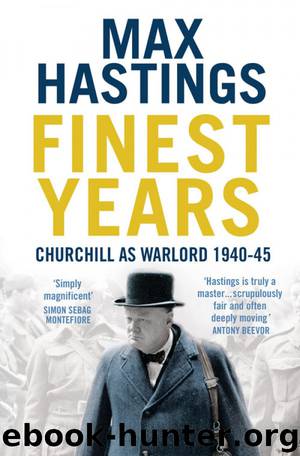
Author:Max Hastings
Language: eng
Format: epub
Tags: Non-Fiction
Publisher: HarperCollins Publishers
FOURTEEN
Out of the Desert
In 1943, to Winston Churchill and to many British, Russian and American people, it sometimes seemed that the Western Allies spent more time talking than fighting Hitler’s armies. Granted, large forces of aircraft battered Germany in a bomber offensive of which much was made in newspapers and cables to Stalin. The Royal Navy, with growing strength, assurance and success, was still waging a vital defensive struggle to hold open the Atlantic convoy routes. US forces fought savage battles with the Japanese in the Pacific. But this was the last year of the war in which shortage of resources severely constrained Anglo-American ground action. In 1944 a vast array of ships, planes, weapons and equipment generated by US industrial mobilisation flooded forth onto the battlefields, arming Allied forces on land, at sea and in the air on a scale such as the world had never seen. Until then, however, Churchill’s and Roosevelt’s armies engaging the Axis remained pathetically small in comparison to those of the Soviets.
The British committed thirteen divisions to North Africa, the Americans six. Of these formations, eight would land in Sicily. Some eleven British divisions in varying states of manning and under-equipment remained at home, training for operations in France or wherever else the prime minister decided to commit them. Additionally, hundreds of thousands of British troops were scattered along the North African littoral, and throughout Egypt, Palestine, Syria, Iraq, Persia and India. These performed logistical and garrison functions of varying degrees of utility, but were not, as Churchill often reminded Alan Brooke, killing Italians, Germans or Japanese. The US Marine Corps was deployed in the Pacific, while General Douglas MacArthur directed a modest army contingent in Australia and New Guinea. In 1943 the latter campaign was dominated by three Australian divisions. A huge Indian Army in India, supplemented by British units, pursued desultory operations, but seldom that year proved able to deploy more than six divisions against the Japanese. At a time when Stalin and Hitler were pitting some 200 apiece against each other in the east, it is scarcely surprising that the Russians viewed their allies’ Mediterranean activities with contempt.
Most Anglo-American historians agree that a D-Day in France in 1943 would have been a disaster. It is only necessary to consider the ferocity of the resistance the Germans mounted in Normandy between June and August 1944 to imagine how much more formidable could have been their response to an invasion a year earlier, when Hitler’s power was much greater, that of the Allies much less. But it infuriated the Russians that the British and Americans exercised to the full their luxury of choice, such as Stalin lacked after June 1941, about when to engage a major German army. It is possible that the Allies might have got ashore in France in 1943, and stayed there. But the casualties of the campaign that followed would have been horrendous, dwarfing those of north-west Europe in 1944-45. While the Russians fought most of their war beneath
Download
This site does not store any files on its server. We only index and link to content provided by other sites. Please contact the content providers to delete copyright contents if any and email us, we'll remove relevant links or contents immediately.
| Afghan & Iraq Wars | American Civil War |
| American Revolution | Vietnam War |
| World War I | World War II |
Waking Up in Heaven: A True Story of Brokenness, Heaven, and Life Again by McVea Crystal & Tresniowski Alex(37808)
Empire of the Sikhs by Patwant Singh(23084)
We're Going to Need More Wine by Gabrielle Union(19045)
Hans Sturm: A Soldier's Odyssey on the Eastern Front by Gordon Williamson(18589)
Leonardo da Vinci by Walter Isaacson(13336)
The Radium Girls by Kate Moore(12026)
Tools of Titans by Timothy Ferriss(8393)
Educated by Tara Westover(8053)
How to Be a Bawse: A Guide to Conquering Life by Lilly Singh(7486)
Permanent Record by Edward Snowden(5846)
The Last Black Unicorn by Tiffany Haddish(5635)
The Rise and Fall of Senator Joe McCarthy by James Cross Giblin(5280)
Promise Me, Dad by Joe Biden(5153)
The Wind in My Hair by Masih Alinejad(5095)
A Higher Loyalty: Truth, Lies, and Leadership by James Comey(4959)
The Crown by Robert Lacey(4814)
The Iron Duke by The Iron Duke(4354)
Joan of Arc by Mary Gordon(4109)
Stalin by Stephen Kotkin(3965)
